Thursday, June 6, 2019

Fish room Equipment


       As mentioned in a recent email to the Keystone and Chesapeake Killie clubs, we are hoping to help the Harper family dispose of fish room equipment.  Some items like the linear piston air pump and the small box freezer may have multiple interested parties.  In such cases those items will be auctioned to find a fair winning bid.  In many cases, items will be free and it is the Harper's desire that such items find a new home rather than a spot in a land fill.  Please get back to me with an interest and I will keep a running list.


Metal stand with two 20 gallon high tanks with individual hoods.


     Stand on the left has 5 shelves holding a total of nine 5.5 gallon tanks and one ten gallon tank.  The stand itself is 36" wide, 18" deep and 6 feet tall.  The second stand on the right is 4 feet by 2 feet by 6 feet, with four shelves.  there are a total of five 5.5 gallon tanks, and twelve 10 gallon tanks.  There are two air line distribution manifolds with individual valves.  I will be interested in the manifolds.

Stand with a couple of shoe boxes


      This is a wooden piece of furniture acting as a fish stand.  The tank on the bottom is 4 feet long by one foot wide and 18 " tall.  Just above it to the left is a 29 gallon tank 30 " by 12 " by 18".  There also is a ten gallon in the picture, and an assortment of critter keepers.


       Same as above but showing more detail for the 29 gallon.


Free standing small chest freezer.

      That's a pretty good overview of the larger items.  There are also nets, smaller air pumps, and all sorts of other items you would expect.  Please come on the 15th to help move all of this stuff out.  Thanks, reply with interests to George at   gdfishman@verizon.net   

Monday, February 20, 2017

Vacation Notes

     Just got home Saturday from our visit to daughter Emily and family in Port Orange, Florida.  We left early on February second, and got back home mid day on February eighteen.  Didn't really get to fish work until the 19th, so the fish were without food for 17 full days.  A male Aphyosemion bivittatum Funge died, but his mate had died just before leaving so something may have been wrong in that tank.  Even the dozen or so small Aphyosemion australe Swartzflosse all seem to be alive.  So the fish are hungry, but swimming.
      The grindal worm cultures did not fare so well.  Of the 16 coir cultures, probably eight of them show little sign of life.  The best cultures are the two that were on foam.  I was about to discard them before I left because they were accumulating dirt, but they still had lively worms.  Took some of those worms to reseed the failed coir cultures.  By day three, all of the cultures are showing signs of recovery.
       The blackworm cultures that I am trying to cultivate are alive, but the worms are thinner after the long stretch without food.  The good news is that I don't have to start from scratch to get colonies to work with.
       About half of the daphnia cultures fared well.  With some green water feedings, I think they will recover quickly.  The cyclops cultures have provided food for the baby fish.
       All of the blue crawfish survived the vacation.  Now I have to try to fatten them up to pair some to try to get some baby crawdads.
       Before I left, I checked the plants with the biv Funge trio for eggs and found a couple.  Took out all of the plants, and put in new java moss and oak leaves.  The plants were put into a peanut jar for the vacation, and one baby was found swimming two days ago.  Checking that tank for eggs this morning, I found and removed a total of nine!  Will leave the trio in the tank for another week before removing the breeders.


Tuesday, November 22, 2016

Hypsolebias trifasciatus egg

       I bought a small bag of Hypsolebias trifasciatus eggs at the Keystone Killie Club meeting on November twelve, 2016.  The eggs were marked "Coll 10.08.2016".  Since the eggs originated from a European fish keeper, that would indicate they were collected on August 8, 2016.  If the eggs needed a 3 to 4 month incubation period, they might be ready now on November 22, 2016 for wetting.  A couple of emails from Keystone members suggested checking the eggs to see if they had "eyed" up.  So I fired up the little microscope and wrestled with remembering how to operate it and take pictures.  Here goes:


      Here is the Hypsolebias trifasciatus egg collected from the peat today.  This shot is at 20x.  To my uneducated eye, I would assume the round circle at the bottom of the egg is the developing embryo, which just might be showing an eye within the inner circle.  In any case, I would not think that this egg is anywhere near ready for wetting.


      Same egg at 30x.  The possible eye shows up a little better.


      When I started this photo session, I was looking for water bugs from a standing sample of aquarium water with a thick algae mulm on the bottom.  The egg is in the corner, and all the little specks are some little creature, with three somewhat larger paramecia in the upper left corner.  Should have used tap water to look at the egg.
      Now the interesting part:


      Two much larger creatures came from somewhere and appeared to be grazing the surface of the egg.  They looked to be fairly developed.


      In this picture it looks fairly similar to a terrestrial deer tick.  Any ideas?
      I did let the water on the slide dry out, then threw this egg away.  Don't want those critters getting any bigger.

Wednesday, February 24, 2016

Take it Off the Bucket List


      I missed the Chesapeake Killie meeting on Saturday because I am visiting my daughter in Port Orange Florida.  Ever since I saw photos of huge redfish in Mosquito Lagoon, I was quite literally hooked myself. These three monsters were caught on blue fish chunks.  Only bait they took today.  Thank you little blue fish that took our shrimp. Then became our wonder bait.

Fish Number 1

The Smallest one, a mere 41"

Fish number 3

Hurry, get him in before the line breaks!
      Wow what a wonderful day.  And yes they were three different fish.  My wife pointed out that my hair is different in the three shots, evidence of the windy day.  Am already planning the next fishing adventure.

Sunday, February 7, 2016

Annulatus Update


      The six annulatus that I Bought from Gary Haas on 9/12/15 turned out to be three pairs.  One pair went into the shallow "Surefresh" four liter box at the top right on 12/3/15. Finally on 1/18/16 I found one lone tiny baby with the parents.

Box A
      This is the Box A with the parents and single baby.  The male is in the lower left corner.  The parents have been fed on a nearly exclusive diet of grindal worms, plus whatever cyclops I find to pour in their tank.

Box B
      On 1/18/16 the parents were moved to this different box with java moss and some floating plants.  The single baby was left in the Box A to see if any other babies would show up.  With my patience wearing quite thin, I was going to move the baby to some other container, but this morning, on 2/7/16, I spotted a second much smaller baby. Finally.  Nineteen days to get the second baby.  And I had checked often to see if any late babies had hatched.  So now the two babies will be left in Box A to grow out.  Maybe some more will pop up while I wait.
      As of 2/7/16 no other babies have been spotted in the other two tanks with the other two pairs of parent annulatus.
      Spotted another tiny baby in Box A on the morning of 2/8/16.  Brings the total to three.
      On Friday, 2/12/16, I found five smaller babies and the one larger one!  Sieved some cyclops from a holding jug and added them to Box A with the babies.
      Since this box method seems to be successful, I moved the breeding pair from Box B to a newly set up Box C.  The pair was in Box B for 3 1/2 weeks and no babies were observed in the box.  Now we wait.

      2/17/16:  Highest count in Box A has still been five small babies and the one larger one.  Put in good collection of cyclops.  Box B has still not produced any babies.

      4/6/16:  Box A count down to two, the original biggest baby, and one surviving secondary baby.  This box was down to just those two after our return from the two week Florida absence in early March.  Both babies moved into separate file card boxes.
      Box C has one tiny baby!  The pair was moved to Box B with a complete water change.
      Box B never had a single baby show up, boo.  Pair moved into Box B to let Box C sit to develop hatch out any additional babies.

Saturday, January 2, 2016

Red Cherry Shrimp


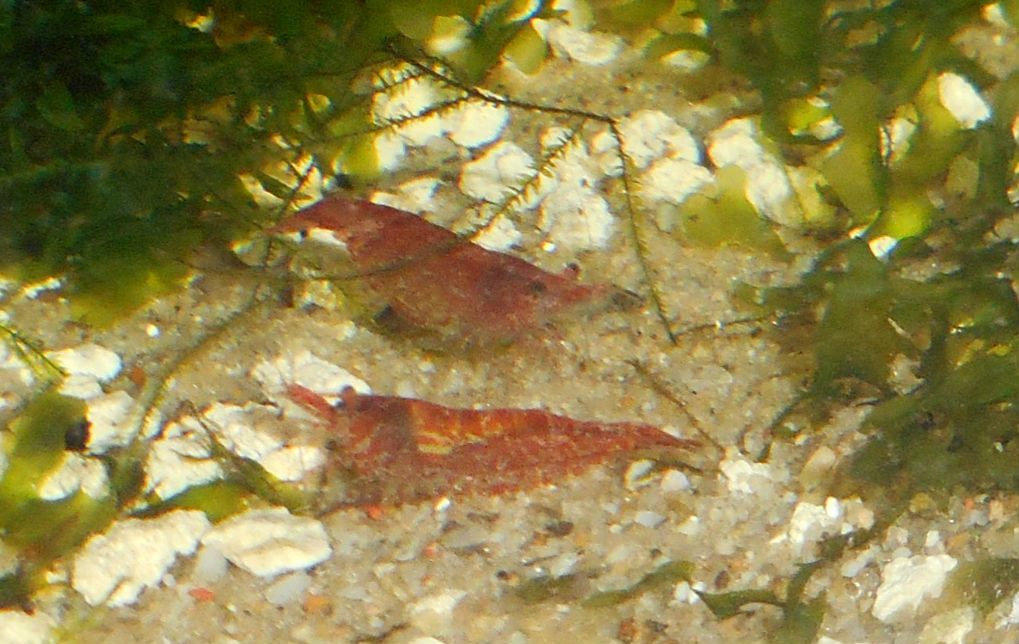
      Here is the 2 1/2 gallon tank that contains five adult shrimp, four females and one lucky male.  He is the much fainter colored shrimp in the black circle to the left.  Two of the females have dropped their babies, resulting in a count of over twenty this morning. Those two shrimp have not berried yet for their next round. The other two females, one on the filter and the other on the lower left are still carrying developing eggs.  I think I will let them go to baby drop, then probably remove all of the adults.


      Same five adults, but here you can just see the back end of a female in the circle.  The male ls at the top left of the plant clump, against the aquarium glass.


      This picture shows five of the baby shrimp in the circles.  As small as they are now, they are at least double the size they were last week.

Friday, December 25, 2015

Growing Scuds

      I purchased some scuds, probably Hyalella azteca, from John Clairmont a couple of years ago.  They went into a ten gallon tank on a bottom row, and were mostly forgotten. Sometime later, when a tank was needed for a purchase of Red Cherry shrimp, I saw no reason to continue wasting a tank on the scuds, so in went the shrimp. They have been coexisting quite well, with increasing populations of both invertebrates. And the tank is pleasingly clean versus my other tanks. Having read that scuds eat both hair algae and black beard algae, I added ten each to two quart containers with black algae problems.


      Probably 15 smaller scuds were added to this 15 gallon that contains a trio of Red Cherry shrimp. The hair algae is thick on the left side of this tank. Obviously the cherry shrimp don't eat it. It will be nice if the scuds clean it up.

Scuds added 12/25/15

Thursday, December 24, 2015

Electric Blue Crayfish Growing


      Back on September 30th I wrote a post about my mother crayfish releasing her babies. You can see her in this shot above taken this morning.  Over a few days time, I had removed a total of 270 baby crays from this 30 gallon breeding tank, and spread them around to various tanks and "holding containers".  The few babies left in the tank with the mother, have turned out to be at least 30 more!  Yikes.  From the original 300, I expect I easily have 120 or more still alive.


      The larger crayfish near the top is the mother of the 300 baby spawn.  Two of the babies in this picture are about half her size at only three months.  Although the original male died, I will certainly have no problem in procuring breeding stock.


Procambarus alleni

Tuesday, December 8, 2015

Red Cherry Shrimp Progress

      The Red Cherry Shrimp are making progress.  The original group in the ten gallon tank in the back seems to be expanding slowly, and there is currently a good sized berried female. The three shrimp in the 15 gallon tank in back are growing, with at least one female with an egg saddle. The best progress is in the 2 1/2 gallon tank that I moved to front and center in the front room. There are six or seven shrimp in that tank, with one female berried and one in saddle (non-fertilized eggs behind head).


      In the shot above, the female with the egg saddle on her back is in the forefront. The berried female is behind her and is facing the camera.


      In this shot you can see the berried eggs that the top female is carrying under her belly. I am going to leave the berried female in the tank through release of the developed babies. The literature suggests that the babies will be fine. The egg saddle is also quite apparent in the second female.

     12/27/15 Starting to see babies in the 2 1/2 gallon tank.  Ten babies counted on 12/28/15.

     1/7/16  Netted out two berried females from the 2 1/2 gallon tank to the 10 gallon tank with annulatus next to it.  Two of the four females in the 2.5 have released their babies, and I have had a count of at least 30 babies.  That seemed like enough, hence the net and move.  Also a male left in the 2.5.

Sunday, November 8, 2015

Changing Tank Day

      Yesterday was the start to a lot of fish moving.  The two male Fd misaje were moved, the older male to the lonely hearts tank, and the younger male to form a breeders trio in a 5 1/2 gallon tank in the back room.
      The five remaining Procatopus similis "Kumba" F-1 of the original seven were moved to the somewhat cleaned up 75 gallon.  Hopefully they will spawn and get surviving fry in that heavily planted and protected tank.  Will leave the 20 they vacated sit for awhile to see if I get babies pop up in that tank.

Procatopus similis "Kumba"
      The surviving lone male Aphyosemion calliurum from Tony Kline was moved to a back room 5 1/2 gallon tank with three of his mature female offspring.  Hope it works.


Friday, October 2, 2015

Red Cherry Shrimp

      For some reason, I struggle trying to keep Red Cherry Shrimp.  Gary Haas in Havre De Grace produces them by the bucketful.  I buy them, put them in my fishroom, and usually kill them. I bought another five shrimp at our September 12th, 2015 meeting in Newark. Two of those shrimp were berried and went into separate quart containers with some tank mulm and plant pieces. Both females survived and released young on about 9/25/15.  The other three adult shrimp went into a 5 gallon tank with a filter and java moss, and yes, those three died!  Go figure.
     So today, 10/2/15, I caught three of the tiny babies from one of the successful releases and transferred them to a well planted 15 gallon tank. Hope to be able to see them sometime in the tank, at which point I will transfer more.  I do have some shrimp in a ten gallon tank that have survived for months, and are producing a few babies. But not yet by the bucketful. But here is a survivor:

Her survival is a good omen

Wednesday, September 30, 2015

Electric Blue Crayfish, Procambarus alleni

      On September 27th, 2015, I noticed that my female Electric Blue Crayfish, Procambarus alleni, had released a batch of babies!  I had put together a pair of adults maybe six or eight weeks ago, but had never seen the female berried.   Finally took the male out as he was basking on top of a rock.  Thought he might be trying to molt, but he has returned to more normal behavior in a separate tank.
      The babies and mother are being fed a combination of sinking pellets and flake food. Remembering that the babies will be cannibalistic, I tried to catch some with a turkey baster.  No luck, the little squirts are fast. Some sinking pellets in a peanut butter jar left in the tank for a few minutes attracts some babies, which are caught by simply pulling out the jar. Now begins the process of catching babies to transfer them to multiple tanks that contain lots of protective cover.


      Here are pictures of the first six baby crays that were caught. At this point. they are just over 1/4 inch long. These six just got a 10 gallon tank of their own! But not for long, see below:
      The latest count:
         
                  Number      Total           Container
9/30/15           6               6            10 gallon tank A  - added 14, see below for 10/3, done
9/30/15          10             16           10 gallon tank B  - added 10, see below for 10/3, done
9/30/15           7              23          2.5 gallon plastic A, done
9/30/15          10             33           15 gallon tank A  - added 20, see below for 10/3, done
10/1/15           7              40           2.5 gallon plastic B, done
10/2/15          30             76            15 gallon tank B, done
10/3/15          20             96            15 gallon tank A  -  now has 30 total, done
10/3/15          10            106           10 gallon tank B  -  now has 20 total, done
10/3/15          14            120           10 gallon tank A  -  now has 20 total, done
10/3/15          20            140           10 gallon tank C, done
10/3/15          10            150             5 gallon tank A, done
10/5/15          40            190           20 gallon long A, done
10/7/15          40            230           20 gallon long B, done
10/8/15          30            260            4 gallon Sweater box, done
10/12/15        10            270            4 gallon Sweater box, done
10/20/15          5            275           1/2 gallon plastic container

      11/24/15  Finally got box filters running in the two 20 gallon long cray tanks in the front room.

      11/29/15   The last listing with 10 crays in a 4 gallon sweater box was taken down this morning.  There were 5 surviving crays that were moved to the twenty gallon high that had already contained five crays from just before our Florida trip that I had accumulated in the 1/2 gallon plastic container listed above. The five crays that had been in the heavily algaed twenty since 10/20 have the best color of any of the babies.

       8/15/16   A new batch of baby crays released in the 30 gallon breeder tank!  Good thing too as my cray population has been steadily decreasing to maybe 10 to 15 left.

Monday, January 5, 2015

Epiplatys infrafasciatus infrafasciatus

      I enjoy the genus Epiplatys, from the diminutive annulatus to the medium sized dageti, and finally to the larger species such as Epiplatys infrafasciatus infrafasciatus.

My male Epiplatys infrafasciatus infrafasciatus
      My Epiplatys infrafasciatus infrafasciatus Mile 4 were purchased for me by Lee Harper at the 2012 AKA Convention in St. Louis.  The fish were raised by Sandy Binder, and received a rating of 90 points. I was thrilled that Lee was able to buy them for only $10 in the auction.  The original pair was very productive, so it was not long before nobody wanted the offspring in our local auctions. It often works that way.


      The picture above is of two of the three females in a fifteen gallon tank with one male. The easy breeding part is long gone, and until last night, I had not seen a baby in well over a year.  But then, there was a speck of dirt in an algae clump that turned out to be a fry.  That rare baby was siphoned out and put into a jar teeming with paramecia.  At least it won't starve.

15 gallon with breeding quartet
29 gallon with breeding pair
      1/5/2015  Large single female from isolated 2 1/2 gallon tank was added to the pair in the 29 gallon tank to form a breeding trio.  Hope to have better luck than the nonproductive pair.

      1/4/2015  Found and removed a small fry from the 15 gallon breeder quartet.  First fry in quite some time.

      5/27/2015  Mile 4 pair purchased at AKA convention.

Hoping for more fry
      9/27/15  I had moved the quartet from the 15 gallon out to the garden in the 100 gallon horse trough. When I emptied every last drop today, I netted the original four, and saw two babies, one of which got lost somehow.  So a couple of months of summer camp resulted in one juvie, but was fun.  Brought in the parents when a threat of low 50's mornings was approaching.

      6/2/16  Caught the four adults that had been moved in 9/27/15.  Yes, all four.  Put back out to the horse trough with some water lettuce, and some bull mosquito larvae.  Good luck to the larvae.

Sunday, December 28, 2014

My youtube of Epiplatys Rathkei Egg

    Here is a youtube clip I made of a developing Epiplatys rathkei egg:    My epy clip

You can even see the blood pumping through the heart.  Wish I still had that fish in my fishroom.


My Microscope is Back


      This shot was from nearly eight years ago when my Motic Microscope was still working. The Motic plugged right into a USB port, and the scope picture came up on the screen. You could take still pictures or videos, add a measuring stick, and add commentary. Then the computer became infected with a virus that stopped just about everything, and since the computer was old and SLOW, I bought a new one. The new computer had a new operating system that Motic did not support, so that was the end of the microscope fun.
       Between yesterday and this morning I spent maybe three hours on the Web reading about getting rid of the old virus.  Using rkill and Malwarebytes, I was successful in getting the old computer to run.  It works the old Motic software and microscope just fine.  Slow as molasses on the internet, but it will now be used only to drive the microscope.  Hope to have new pictures soon and often.
       Here are the rest of the pictures from 2006 and one from 2008:


Moina 3-31-06


Bosmina, 50 power


Saturday, December 20, 2014

Electric Blue Crawfish

      My first experience with the Electric Blue Crayfish, Procambarus alleni, was to purchase a bag of three adults at the Keystone Killie Club picnic held at my house on August 18, 2012.  I got babies from that trio and raised them to adulthood, and got more babies again.  All of this activity was with the crays all together in a 15 gallon tank.  In that batch there was a berried female that I isolated to a 2 gallon tank, where she released all of her babies about a month later.  Shortly after that I separated babies into various tanks and counted them during the process.  178 babies!  I should be swimming in crawfish.

My largest male, December 20th, 2014
      Over time, the general wisdom about the babies being cannibalistic proved to be true.  Out of the brood of 178 babies, I managed to save only five to about the two inch size, less five that I was smart enough to sell as babies.  So it was time to try to breed them, as no new berried females were noticed.  I had separated my one large and five smaller adults to save them all.  Figured out how to sex them, and discovered my problem. All males.  Last month I visited with the buyer of my five babies.  Alas, he had only one survivor, which also was a male.  The seller of my original trio apparently has lost his crays, so I was in a pickle with six males. Having found no luck tracking down any crays at all in local stores, I started following Aquabid, where I had never had the courage to make a purchase.  Well, now I had no choice.
     http://onestopaquatics.com/ had several listings of blue crays, and after several email exchanges with Jerry, I arranged to buy five females at 8 dollars each, plus 17 dollars shipping.  They arrived yesterday packed in separate little bags, and I left them overnight in small containers.  One had actually shed during her trip in the mailing box.  This was my first transaction with Aquabid, and I think it and One Stop to be good for more business.
     Here is a good site for info on blue crays: Aqua-terra Crayfish care.  There is useful info on how to breed the crays, so I put a female in with a male, and he tried to mate with her immediately.  He was aggressive, and pulled off a claw, so I removed the female to a separate tank to recover.  A second female went in with a Form II male, and no mating occurred within twenty minutes.  The female was a bit small anyway, so she went to a grow out tank.  A third pairing resulted in breeding behavior immediately, and the female was within the male's embrace for about 15 minutes.  Upon separation, she was moved to an isolation tank where she hopefully will berry after receiving a sperm packet from the mating. The female that had molted in the bag is in an isolation tank to harden off before I try to breed her.  A fourth female was put in with a different male that turned out to be very aggressive, so she was taken out.  Upon further reflection, I concluded that the females would benefit from resting and feeding after their shipping experience.  So after day one:

           Female #1:  Claw ripped off, put to recovery
           Female #2:  In with Form II male, put to grow out tank
           Female #3:  Apparently successful mating, put to separate tank to berry
           Female #4:  Smallish, put to grow out tank
           Female #5:  Smallish, put to grow out tank

Same cray from above


Friday, October 31, 2014

My Fishroom Notes

      3/27/17  Started feeding some scuds to bochtleri, sheeli, misage, and splendopluere.  All of those chased down the scuds.

      1/30/17  Moved plants and Funge pair from Box B.  Never found any eggs in the plants in the box.  The Funge had not been eating the glassworms, so I sucked out as many as I could catch.

      1/16/2017 I bought Hypsolebias sertanejo Itacarambi  and Hypsolebias alternatus Brasilandia BR 2014-07  eggs at the Keystone meeting on Saturday 1/14/2017.  Both bags of eggs were collected on October 1, 2016, so I put half of the peat from the bags into separate containers with a little water added on at about 3:00 PM on 1/15/17.  
     By 9:00 AM 1/16/17 I have two baby sertanejo that I have moved to a separate container with infusuria and cyclops.  Unhatched eggs can still be seen in the peat at the bottom of the hatching container, so I will give it more time.
     None of the alternatus have hatched by 10:00 AM, but an inspection of the peat in the hatching container revealed at least 1/2 a dozen eggs, with some appearing to be eyed up.  They will stay in the container for awhile longer.
     But yahoo, I have babies from purchased eggs!  That's a new one for me as I have not tried very often to hatch eggs.

    11/2/16  Added dry oak leaves to several breeding set ups.

     5/30/16  Found two tiny dageti fry in empty Box D!  Neither survived as of 11/2/16.

     5/16/16  Female dageti dead in Box D.  Moved male to a 2 1/2 gallon tank.

     5/11/16 Cleaned some algae out of Box D that has had a pair of Epyplatys dageti for at least six months with no babies.  Added several sprigs of horn wort, Ceratophyllum demersum.

      4/20/16 Checked breeder box C for sheeli eggs.  Removed two eggs!!  Maybe it is a start.

      4/12/16 Pair of Aph sheeli moved from 5 1/2 gallon tank to breeder box C with some java moss to make a push for collecting eggs.  Never had a natural spawn from the pair.

      1/17/16 The two large Aph sheeli males were taken to the January meeting for Gary Haas. Unfortunately, the large male killed the largest of the female juvies in just the short time he was paired with her. Took one of the two pair from a 5 gallon in the front room and moved that pair to the sheeli tank that was vacated in the back.  Any babies that might hatch from the deceased female would be the same strain.
      Clay Crawford emailed me to see if I still had the sheeli, as Mike T no longer has them. I asked Clay if he would like a pair in March. Then I could pull a pair of the parents to see if babies would hatch in the vacated tank.

      12/24/15 Moving Aph sheeli around: The seven red dot juvies of 2/23 and 2/24 survived to be 3 males and two females.  In addition there were an earlier three juvies in back that are now all good sized females. The largest female was paired with a large male on the south wall 5 gallon tank. Hope she survives the pretty aggressive male. A small male was discovered in the breeding tank out front that had only a large male left. Two of the front three tanks now have young pairs, and the third tank has 2 pair. The odd large male is being kept for Gary Haas for the January meeting.

      12/19/15 The two smaller shrimp in the ten gallon tank are starting to color and appear to have saddles forming. The largest of the three is definitely a saddled female. I caught one of two shrimp from the 2 1/2 gallon that appear to be non colored males. Moved him to the ten gallon tank, so that is now a quartet.  The 2 1/2 now has a suspected male, two berried females, a saddled female, and a suspected female.

      12/15/15 Moved young pair of Red Dot Sheeli to 5 gallon tank in front room, middle shelf.

      12/9/15 Caught about 18 scuds from tank in back with Red Cherry Shrimp using a piece of cucumber in a weighed down peanut butter jar. Moved about 9 to the 2 1/2 gallon tank on the bottom rack in the front room, and moved the others to a 2 1/2 gallon plastic tank in back. Maybe I will at least get fish food from those unused tanks.

     12/5/15 One of the female shrimp in the 2 1/2 gallon tank is berried. Judging by her size, she may be the original mother shrimp. Saw two differently colored shrimp in the 10 gallon tank, so I assume I now have a trio there.

     12/3/15 Was going to use flat grow out box from 11/11/15 Dageti, but it has at least two tiny babies. Starting them on some mini worms that popped up in a grindal culture.  The two cherry shrimp from 11/21/15 now appear to be two females. Added a supposed male from the 2 1/2 gallon tank. Also added a pair of P. annulatus to the 10 gallon tank with the three shrimp.
   
     11/21/15 Caught what appear to be a pair of cherry shrimp (coloration of one more intense and curved underbelly) from the 2 1/2 gallon tank that has five or six babies and the mother shrimp.  The two were moved to a 10 gallon tank on the front stand.  There seem to be three small males and two larger female juvies still in the 2 1/2 gallon tank.

     11/11/15 Moved trio of Dageti from flat grow out box to 2 1/2 tank on back rack.  

     4/21/15 Harvested first mosquito larvae today, before they went to the bullet stage.  I am getting rid of the big containers with water, that is anything above 5 gallons because it is too tedious to harvest them frequently to prevent the flying buggers.  But after seeing again today how much the fish love them, I will maintain a number of smaller containers.

     1/20/15  Saw first baby in the vacated Misaje tank!  Proves the pair is fertile.  Three weeks for a baby to appear, I was getting doubtful.  The pair has been spawning actively in the new tank, so hopefully I can rebuild the Misaje population.
 
      1/4/15  Moved floating bunch of java moss in 5 gallon tank that had the dageti and found two tiny fry at the surface.  Also noted a larger fry with nice belly.
      Checked the 15 gallon tank with one male and three female Epiplatys infrafasciatus infrafasciatus and thought there was a fry at the surface in some grass.  Indeed there was!  This is the first fry in over a year.

      12/31/14  Moved trio of Dageti from 5 gallon out front to 2 1/2 gallon in back.  The one baby found in breeding tank from 11/30/14 did not survive, probably starved.
      Moved pair of spoorenbergi to adjacent tank and added a plump female for a breeding trio.  Tank left to age to check for future babies.  Never got any babies from tank vacated 10/25/14, which is now again the breeding tank.
      Adult male and female Aph. sheeli red dot that have been kept separately were paired today in a five gallon tank.  Breeding behavior noticed immediately.    

      12/30/14 Noticed a single baby three days ago in the Aph sheeli red dot tank with parents bought 10/11/14 from Mike T.  Should have tried to catch the baby then, as I have not seen it since. Drained two thirds of the tank this morning, and caught four babies!  Put two each into separate grow out containers. Left the parents in the tank.
      Moved the two remaining Aph calliurum juveniles to the tank with the other two.  Have not seen any other babies in the tank with the parents.
      Removed pair of Fd misaje from breeding tank with water lettuce set up 12/3/14.  Put back into breeding tank that has been vacant since 12/3 with no babies found.

      12/30/14 Two of the goldfish have died, but I am getting green water so the daphnia are doing well. The goldfish did not knock the duckweed down, so I have been removing it from the tank.  Maybe the last fish will clean up duckweed stragglers.

      12/2/14 Bought three goldfish for $.32 each at Petsmart to try to get a 10 gallon tank to go to green water for daphnia food.  Also a way to use duckweed.

      11/30/14  Found and moved one baby dageti from the parents off tank.  Proves that trio to be fertile.

      11/14/14  Moved four of the five cherry shrimp to a 10 gallon with newly installed sponge filter.  Put in the java moss that had been in their holding tank in case it has baby shrimp.  The one female that apparently is berried was moved into the five gallon tank with four albino incistrus.

      11/13/14  Caught two more Aph calliurum babies and moved to separate grow out container.  Now makes a total of four babies, with the first two much larger than the two caught today.

      11/8/14  The monthly meeting was hosted by Jack Lafayette at his home in Reading.  He has a lot of bigger tanks, many with rift lake cichlids.  Bought a bag of unsexed juvenile Aplocheilus linneatus F3 from Lee Harper for $5 and a bag of 5 cherry shrimp from Gary Haas for $5.  Several of the shrimp are berried.
      Bought a pound block of frozen brine shrimp.  All fish took to it immediately.
      Got two male Aph bit ijebu ode males from Lee Harper.  Paired them with my two lonely females in separate 2 1/2 breeder tanks.

      10/31/14  Single small baby Aph calliurum spotted in tank with trio from Tony Kline from purchase at September 2014 meeting.  This was the first baby spotted.
       Pair of Epy dageti moved from 2 1/2 gallon to five gallon with single male, forming a reverse trio to try to breed. The 2 1/2 left set up to check for babies.
       Scriptaphyosemion schmitti juarzon male moved to singles tank.  Was dead by evening.  Solved that lonely heart problem.
       Male and female Fd gardneri misaje raised separately were paired in 5 gallon tank vacated by schmitti.  Still have a single female that should be put in rotation.
       The larger female in the spoorenbergi trio has been a little beaten.  Moved her over a tank to recover.

     10/25/14 Removed breeding trio of spoorenbergi from their tank.  Put male in with the other two females, and moved the females from his trio to another tank to fatten up.  Some of the floating plants from their breeding tank were moved to a 2 1/2 gallon holding tank to see if some babies might hatch.

     10/1/14  Same old story.  One male spoorenbergi died.

      9/20/14  Got 2 pair of Fd spoorenbergi from Gary Greenwood.  I really like this species and want to establish it in my fishroom.  The last time I bought two pair, one male jumped and the other died a short time after purchase.  Still had two females surviving, so now have two trios.
        Also bought pair of Scriptaphyosemion schmitti juarzon from Gary.  Female did not look happy and died a few days later.

Saturday, February 15, 2014

Keeping Blackworms Alive

      My typical method for keeping blackworms is to buy 1/2 pound for around seven dollars, rinse them, drain out most of the water, then keep them in the bag in my downstairs fishroom fridge.  Use some over the next few days, do a couple of rinses, then forget.  When the fridge begins to smell, it is time to once again own up to the fact that I blew another seven dollars.
      Our Keystone Killie Group meeting last week was at Jack LaFayette's house in Reading, PA.  Jack keeps his blackworms in a fifty gallon aquarium with just a few inches of water.  He does make occasional water changes, and does keep his worms alive.  Having seen his set up, I decided to try my luck with my newest 1/2 pound of blackworms by keeping them in my fishroom.
      Not having a 50 gallon tank in waiting, I decided to try a two gallon set up instead!  I rinsed the worms, then put them in the little plastic aquarium with a small sponge filter made by Aquarium Technology.  I am sure that that oxygen delivered from the sponge filter is critical to the keeping of the worms.
      I was expecting a bloody mess after day one, but the water was not too bad.  I discarded the water, rinsed the worms, then added aged rain water.  So far, so good.


      This is a picture of the blackworm tank taken this morning before a water change.  I have changed the water maybe three times this week, using the spent water to feed my daphnia.  Note how clean the water is after the first week.


      Here is the tank before changing the water.  Note the filter at the right part of the picture.

Worms like to congregate on the filter
Filter with worms in small plastic container
Worms that fell from filter, ready to feed to fish

      This is a picture of some of my daphnia containers after I had used the spent blackworm water to fill them back up.  I had run half of the water from each container through a brine shrimp net to capture the daphnia.  The spent daphnia water was used to refill the blackworm tank.

Back in operation.  No fuss, no smell.

      I have a couple more of the little sponge filters to run other experiments.  Currently I am not feeding the blackworms, so their nutritional value as a fishfood should decrease over time.  I would like to set up more tanks at a lesser density of worms and feed them to see if I can actually cultivate blackworms.
      But so far, so good.  Have not blown this last batch of worms.  Jack, thanks for the inspiration and motivation to try this approach.