I bought a small bag of Hypsolebias trifasciatus eggs at the Keystone Killie Club meeting on November twelve, 2016. The eggs were marked "Coll 10.08.2016". Since the eggs originated from a European fish keeper, that would indicate they were collected on August 8, 2016. If the eggs needed a 3 to 4 month incubation period, they might be ready now on November 22, 2016 for wetting. A couple of emails from Keystone members suggested checking the eggs to see if they had "eyed" up. So I fired up the little microscope and wrestled with remembering how to operate it and take pictures. Here goes:
Here is the Hypsolebias trifasciatus egg collected from the peat today. This shot is at 20x. To my uneducated eye, I would assume the round circle at the bottom of the egg is the developing embryo, which just might be showing an eye within the inner circle. In any case, I would not think that this egg is anywhere near ready for wetting.
Same egg at 30x. The possible eye shows up a little better.
When I started this photo session, I was looking for water bugs from a standing sample of aquarium water with a thick algae mulm on the bottom. The egg is in the corner, and all the little specks are some little creature, with three somewhat larger paramecia in the upper left corner. Should have used tap water to look at the egg.
Now the interesting part:
Two much larger creatures came from somewhere and appeared to be grazing the surface of the egg. They looked to be fairly developed.
In this picture it looks fairly similar to a terrestrial deer tick. Any ideas?
I did let the water on the slide dry out, then threw this egg away. Don't want those critters getting any bigger.
Tuesday, November 22, 2016
Wednesday, February 24, 2016
Take it Off the Bucket List
![]() |
| Fish Number 1 |
![]() |
| The Smallest one, a mere 41" |
![]() |
| Fish number 3 |
![]() |
| Hurry, get him in before the line breaks! |
Sunday, February 7, 2016
Annulatus Update
The six annulatus that I Bought from Gary Haas on 9/12/15 turned out to be three pairs. One pair went into the shallow "Surefresh" four liter box at the top right on 12/3/15. Finally on 1/18/16 I found one lone tiny baby with the parents.
![]() |
| Box A |
![]() |
| Box B |
As of 2/7/16 no other babies have been spotted in the other two tanks with the other two pairs of parent annulatus.
Spotted another tiny baby in Box A on the morning of 2/8/16. Brings the total to three.
On Friday, 2/12/16, I found five smaller babies and the one larger one! Sieved some cyclops from a holding jug and added them to Box A with the babies.
Since this box method seems to be successful, I moved the breeding pair from Box B to a newly set up Box C. The pair was in Box B for 3 1/2 weeks and no babies were observed in the box. Now we wait.
2/17/16: Highest count in Box A has still been five small babies and the one larger one. Put in good collection of cyclops. Box B has still not produced any babies.
4/6/16: Box A count down to two, the original biggest baby, and one surviving secondary baby. This box was down to just those two after our return from the two week Florida absence in early March. Both babies moved into separate file card boxes.
Box C has one tiny baby! The pair was moved to Box B with a complete water change.
Box B never had a single baby show up, boo. Pair moved into Box B to let Box C sit to develop hatch out any additional babies.
Saturday, January 2, 2016
Red Cherry Shrimp
Here is the 2 1/2 gallon tank that contains five adult shrimp, four females and one lucky male. He is the much fainter colored shrimp in the black circle to the left. Two of the females have dropped their babies, resulting in a count of over twenty this morning. Those two shrimp have not berried yet for their next round. The other two females, one on the filter and the other on the lower left are still carrying developing eggs. I think I will let them go to baby drop, then probably remove all of the adults.
Same five adults, but here you can just see the back end of a female in the circle. The male ls at the top left of the plant clump, against the aquarium glass.
This picture shows five of the baby shrimp in the circles. As small as they are now, they are at least double the size they were last week.
Friday, December 25, 2015
Growing Scuds
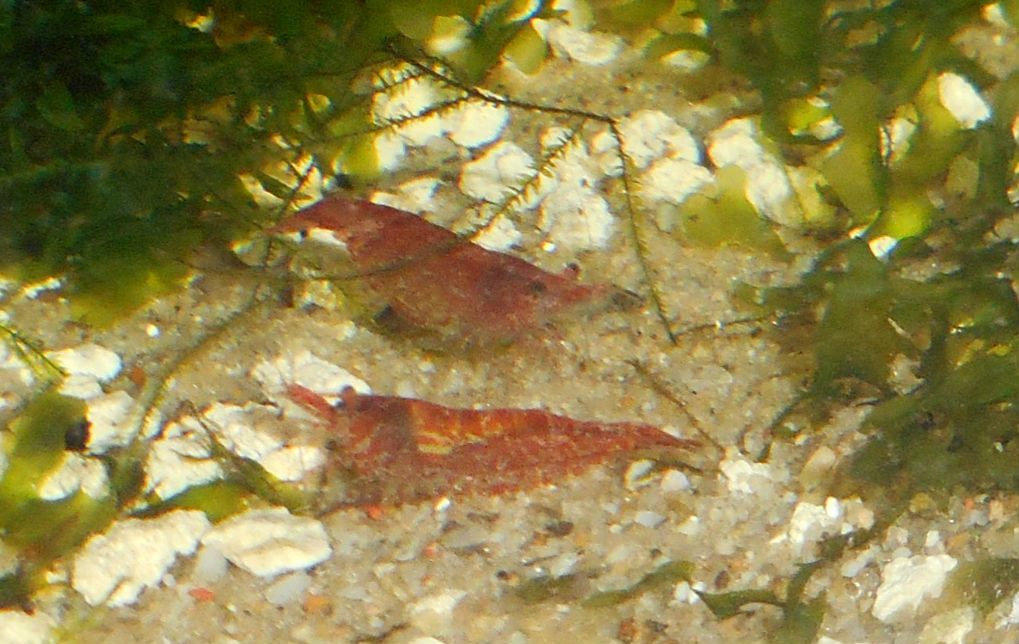
I purchased some scuds, probably Hyalella azteca, from John Clairmont a couple of years ago. They went into a ten gallon tank on a bottom row, and were mostly forgotten. Sometime later, when a tank was needed for a purchase of Red Cherry shrimp, I saw no reason to continue wasting a tank on the scuds, so in went the shrimp. They have been coexisting quite well, with increasing populations of both invertebrates. And the tank is pleasingly clean versus my other tanks. Having read that scuds eat both hair algae and black beard algae, I added ten each to two quart containers with black algae problems.
Probably 15 smaller scuds were added to this 15 gallon that contains a trio of Red Cherry shrimp. The hair algae is thick on the left side of this tank. Obviously the cherry shrimp don't eat it. It will be nice if the scuds clean it up.
| Scuds added 12/25/15 |
Thursday, December 24, 2015
Electric Blue Crayfish Growing
Back on September 30th I wrote a post about my mother crayfish releasing her babies. You can see her in this shot above taken this morning. Over a few days time, I had removed a total of 270 baby crays from this 30 gallon breeding tank, and spread them around to various tanks and "holding containers". The few babies left in the tank with the mother, have turned out to be at least 30 more! Yikes. From the original 300, I expect I easily have 120 or more still alive.
The larger crayfish near the top is the mother of the 300 baby spawn. Two of the babies in this picture are about half her size at only three months. Although the original male died, I will certainly have no problem in procuring breeding stock.
| Procambarus alleni |
Tuesday, December 8, 2015
Red Cherry Shrimp Progress
The Red Cherry Shrimp are making progress. The original group in the ten gallon tank in the back seems to be expanding slowly, and there is currently a good sized berried female. The three shrimp in the 15 gallon tank in back are growing, with at least one female with an egg saddle. The best progress is in the 2 1/2 gallon tank that I moved to front and center in the front room. There are six or seven shrimp in that tank, with one female berried and one in saddle (non-fertilized eggs behind head).
In the shot above, the female with the egg saddle on her back is in the forefront. The berried female is behind her and is facing the camera.
In this shot you can see the berried eggs that the top female is carrying under her belly. I am going to leave the berried female in the tank through release of the developed babies. The literature suggests that the babies will be fine. The egg saddle is also quite apparent in the second female.
12/27/15 Starting to see babies in the 2 1/2 gallon tank. Ten babies counted on 12/28/15.
1/7/16 Netted out two berried females from the 2 1/2 gallon tank to the 10 gallon tank with annulatus next to it. Two of the four females in the 2.5 have released their babies, and I have had a count of at least 30 babies. That seemed like enough, hence the net and move. Also a male left in the 2.5.
In the shot above, the female with the egg saddle on her back is in the forefront. The berried female is behind her and is facing the camera.
In this shot you can see the berried eggs that the top female is carrying under her belly. I am going to leave the berried female in the tank through release of the developed babies. The literature suggests that the babies will be fine. The egg saddle is also quite apparent in the second female.
12/27/15 Starting to see babies in the 2 1/2 gallon tank. Ten babies counted on 12/28/15.
1/7/16 Netted out two berried females from the 2 1/2 gallon tank to the 10 gallon tank with annulatus next to it. Two of the four females in the 2.5 have released their babies, and I have had a count of at least 30 babies. That seemed like enough, hence the net and move. Also a male left in the 2.5.
Subscribe to:
Posts (Atom)